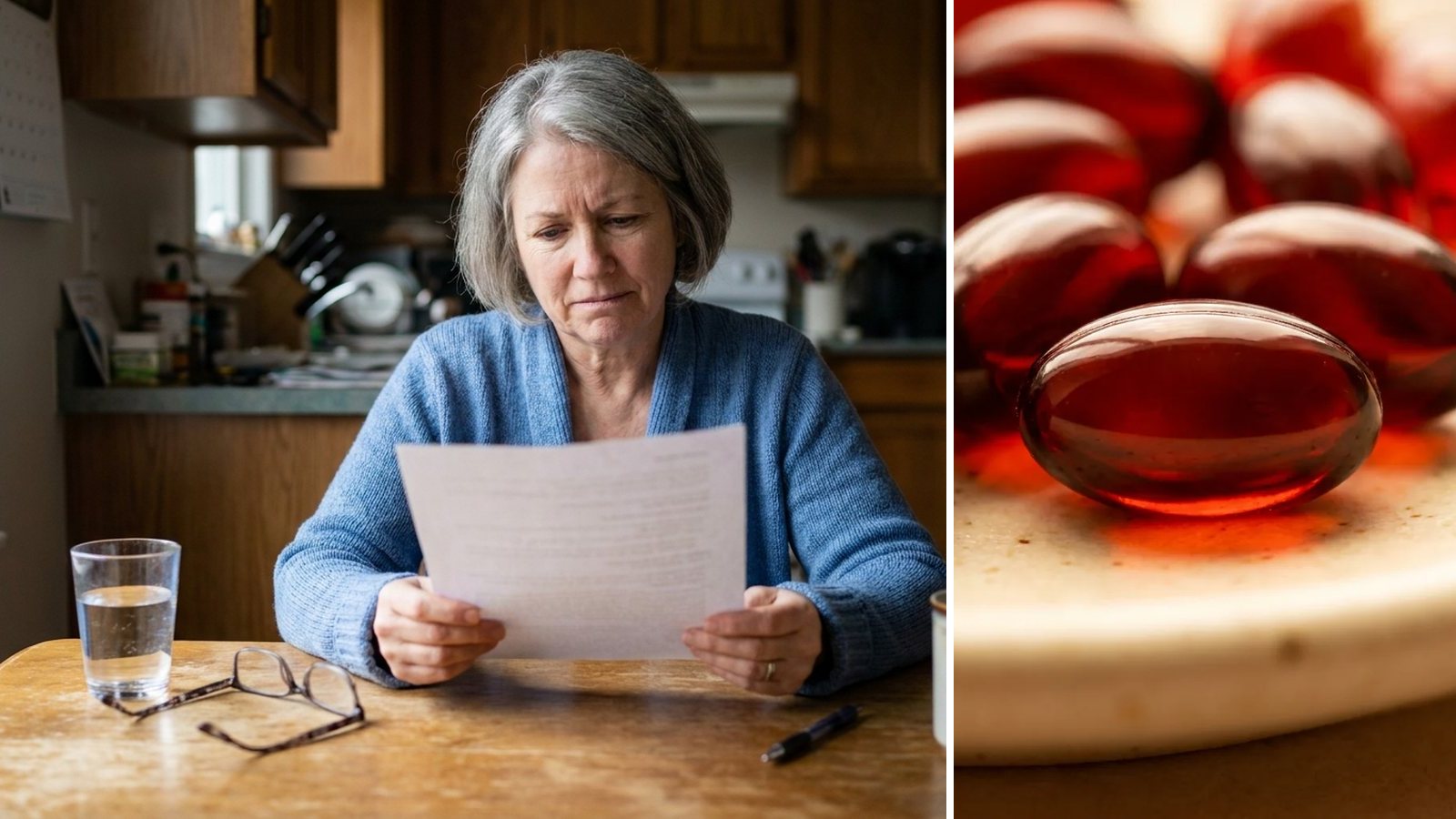

I found out on a Tuesday, from a sheet of paper. My yearly blood panel had a flag on it.
My kidney numbers had moved the wrong way, and I felt fine. Nothing hurt. My body had not said a word.
What finally explained that flag did not come from my doctor. It came from one paragraph in a kidney study, which I read at my kitchen table long after midnight.
I rolled my eyes the first time through. Then I read it twice more. I'll give you that paragraph in plain words further down, because it changed what I do every morning.
I felt fine. So why had my kidney numbers moved?
I'm 66. I walk two miles most mornings. I gave up soda years ago, I drink my water, and I watch my salt.
I take what I'm prescribed, and I haven't missed a checkup in eleven years. Sit beside me at church and you'd never guess a thing.
So I sat at my kitchen table with that sheet in my hands, and I felt cheated. If this happens to people who do it right, why do it right?
A sore knee tells you. A bad tooth tells you. Kidneys say nothing, so you find out from a number that has already moved.
The plan for my kidney numbers: “Let's keep an eye on it.”
My doctor is a good one, and I've seen her for eleven years. She read the sheet and said we'd keep an eye on it. We'd test again in six months.
I had brought a list of questions. I left with a date on a card.
I don't blame her. Watching is her job, and she does it well. But six months is a long time to do nothing about a thing you can't feel.
What I tried for my kidneys while I waited
I went home and did what people do. I tried harder.
More water. Eight glasses a day, then ten. I was up all night, and that was the only thing that changed.
Less salt. I read every label in my kitchen. Dinner got dull. And I had no way to know if my kidneys noticed.
A multivitamin, because the bottle said “complete.” Then a kidney blend with nine herbs I could not pronounce. Forty dollars a month, to feel like I was doing something.
Then an email would come from the patient portal, and I'd feel it in my stomach before I read a word. I doubt I'm the only one who opens those with one eye shut.
I wasn't the only one with kidney numbers like mine
One night I couldn't sleep. I carried my laptop to the kitchen table and typed my question into a search box.
I landed on a message board. Page after page, people I had never met were writing out my own thoughts.
A man of 71 who walked every day. A retired nurse. A woman younger than my daughter.
They were kind to each other, and I was glad of the company. But by the third page I saw what was missing. Everybody had the worry. Nobody had the reason.
The night I read the kidney research for myself
So I left the message board and went looking for the studies themselves.
I read slowly, with a dictionary open in another window. I did not follow all of it. I followed enough.
All my effort had gone into my plate and my water glass. The research was about something smaller, the kidney cell itself.
Here's the picture I wish somebody had drawn for me that first Tuesday.
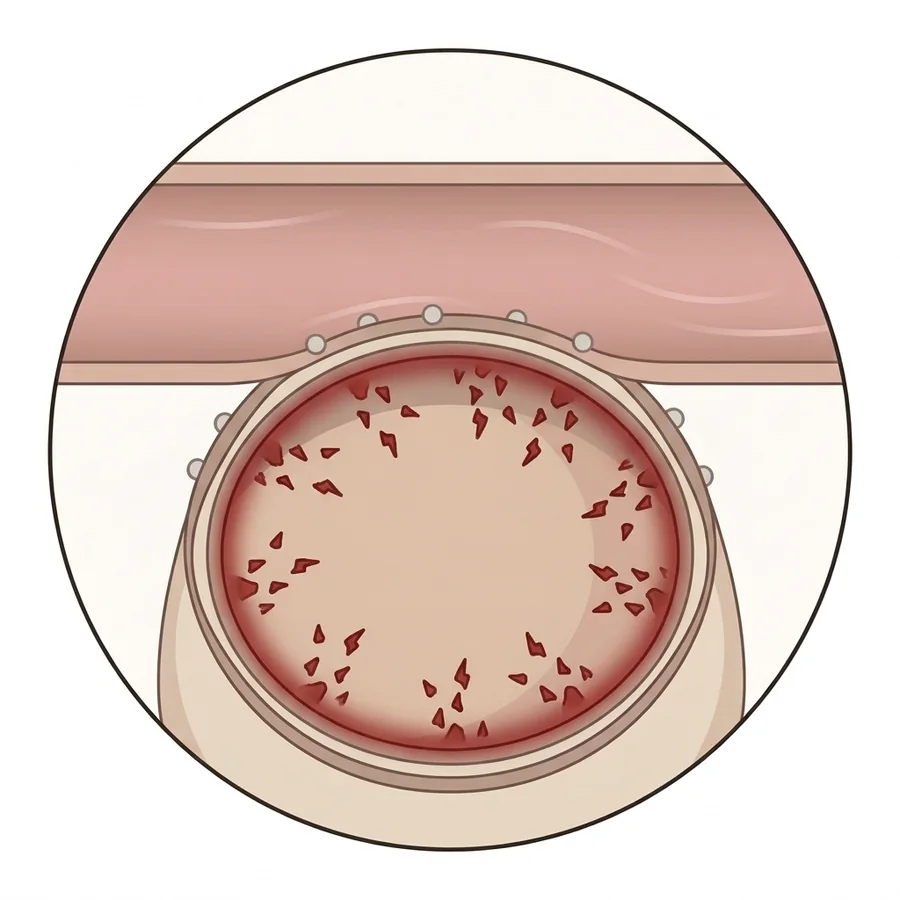
What wears on your kidneys as you age
All day long, your body makes unstable oxygen molecules. They come from food, from stress, from being alive. They knock into your cells and wear them down, a little at a time.
When you are young, your body cleans up after them. After 50, the cleanup falls behind.
Doctors call that wear oxidative stress. It works the way rust does. Slowly, and without a sound.
Your kidneys filter your blood around the clock, through vessels thinner than a hair. That much work means that much wear. The cells that line those vessels take it.
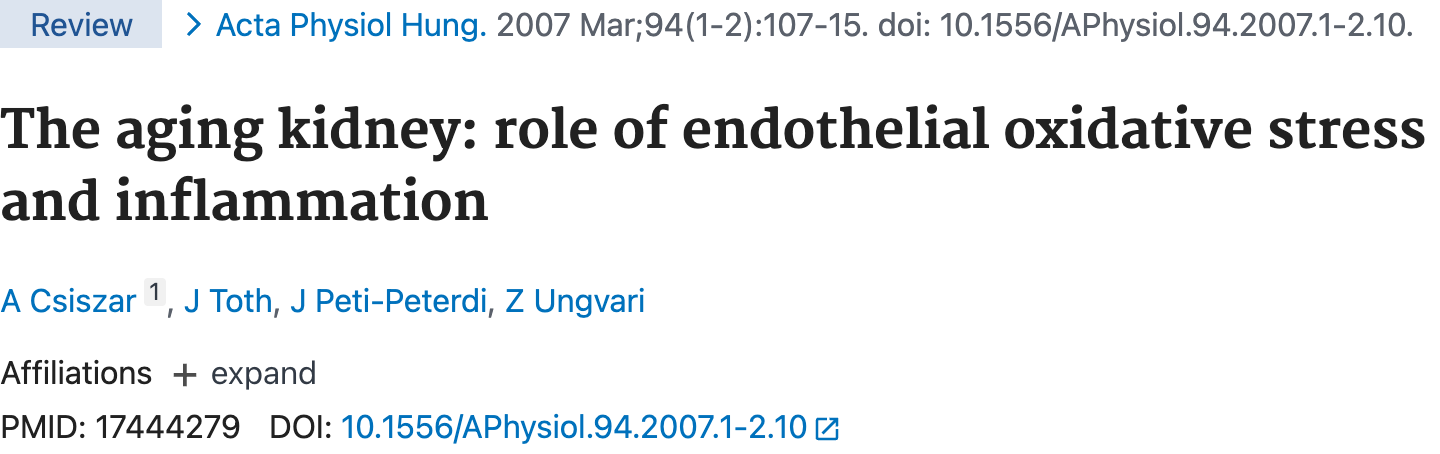
That is the study. The paragraph I promised you is written for scientists, which is why I rolled my eyes. In plain words, the authors make this case. As we age, oxidative stress in the blood vessels has a large part in how a kidney changes.
In eleven years of checkups, I had never heard those two words. Nobody was hiding them from me. A fifteen-minute visit can only hold so much.
Why my vitamins never reached my kidney cells
What I read next sent me to my kitchen counter, to look at every bottle I owned.
The wear starts inside the cell, and no glass of water can rinse in there.
Vitamin C stays in the fluid around the cell, and vitamin E settles on the surface of the cell wall. Neither one guards the inside.
Most pills never get even that far. They ride around in your blood. The water-soluble ones get filtered and flushed by the same kidneys you're trying to help.
It's like waxing a car door that's rusting from the inside. The wax is real. It's just on the wrong side.
By two in the morning I had my own name for it. Rust on the inside. Once you've pictured it, you never look at a vitamin bottle the same way.
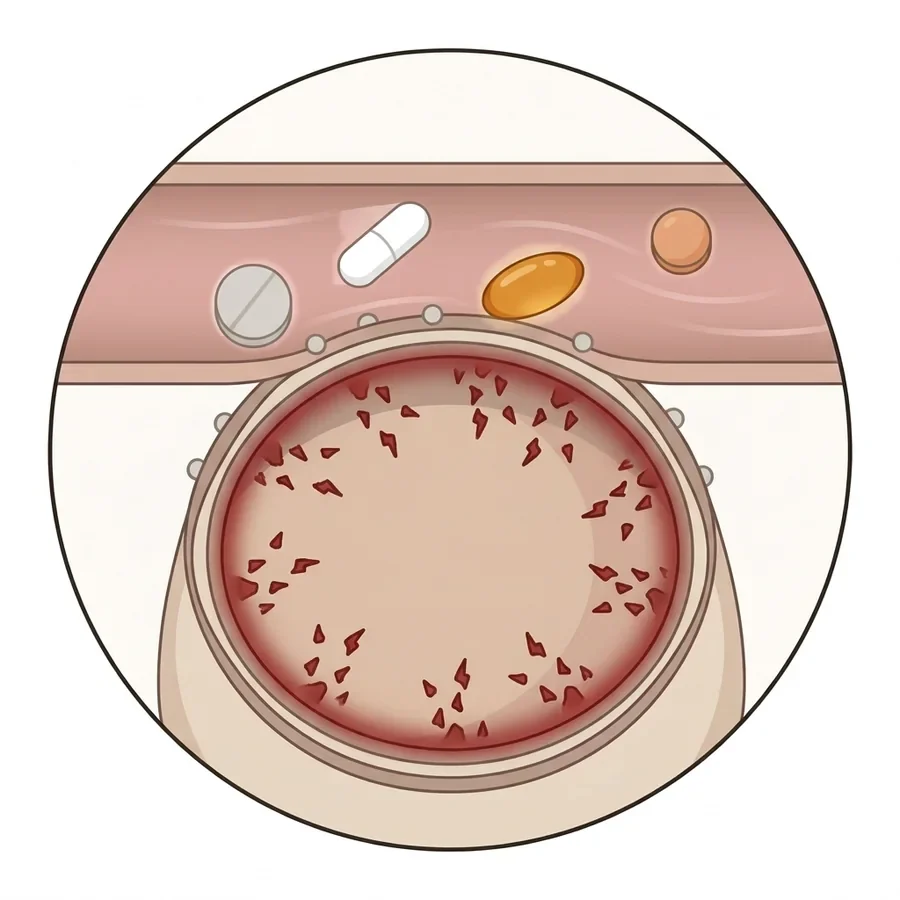
Everything I had tried for my kidneys, looked at again
Once I knew where the wear starts, my whole list made sense.
The water and the salt. Good habits, and I've kept both. The water rinsed my blood, but it couldn't rinse the inside of a cell. The low-salt dinners were good for my blood pressure, and that was their whole job.
The multivitamin and the herbs. The multivitamin was mostly water-soluble, so my kidneys had to filter it out. The nine herbs were nine more things for them to handle.
The vitamin C and the vitamin E in my multivitamin. Real antioxidants, and I still take them. Good as they are, both stop at the door. Every bottle on my counter was wax.
I don't regret one of those bottles. Each one did the job it was built for.
Now I'll tell you something I had never said out loud. When that number moved, I thought it was me. A dinner out. A walk I skipped. Some weakness of mine.
That night, at my kitchen table, with a cup of tea gone cold, I felt my shoulders come down. It was the first time in months.
My kidney numbers were never about how hard I tried
The whole thing was about where my trying could reach.
For months I thought I was failing. I was not. I had been waxing the outside of a door that rusts from the inside. I'll admit I was a little cross about all that blame.
By breakfast I had a new question. What works from the inside?
What the right nutrient would have to do for a kidney cell
So I wrote down what I was looking for. Three things.
It had to reach the inside of the cell, where the wear starts. It had to guard the cell wall on both sides, inside and out. And it couldn't be one more thing for my kidneys to filter.
That last one ruled out almost everything on the shelf.
The red nutrient that kept coming up as I read about my kidneys
The same pigment kept showing up in the papers I read. It's deep red, and a tiny freshwater algae makes it. Wild salmon get their color from it.
It had a name I had to practice. Astaxanthin. You say it asta-ZAN-thin.
Astaxanthin is a long molecule, long enough to lie across the whole cell wall. One end rests on the outside. The other end rests on the inside.
So it guards the inside, where the rust starts and my vitamins never reached. It guards the outside as well. It also reaches the eyes and the brain.
When I first read that, it sounded too tidy to be true. So I kept reading.
It held up. There are more than 60 clinical studies on astaxanthin. In lab tests it has 6,000 times the power of vitamin C against one kind of unstable oxygen.
What the research said about kidney cells, and what it didn't
I had stayed up that night for my kidneys. They do all that filtering through vessels thinner than a hair, and kidney cells were where I wanted a guard.
One more finding, and I want to be careful with it. In lab work on kidney cells, astaxanthin also switched on the cell's own defenses. That was cells in a lab, not people. I still thought it was worth knowing.
That was enough for me. I'd keep doing everything my doctor asked, and I'd add one thing of my own.
All I wanted was something I could start on a Monday morning, without waiting six months to begin.
“Isn't that one more pill for my kidneys?”
That was my first question too. I had read the stories about supplements being hard on kidneys.
The answer is in how it dissolves. Most supplements dissolve in water, so your kidneys filter them and flush them. Astaxanthin dissolves in fat. It gets taken up into the cell wall.
So one softgel is less work for your kidneys than most multivitamins.
That left me with two fears. A softgel with too little in it. Or a softgel with things in it I didn't want.
Three things to check on any astaxanthin label
I thought any bottle would do. I was wrong about that too.
The dose. Look for 12 mg in one softgel. Many brands carry 4 to 6 mg.
The source. Natural astaxanthin comes from microalgae. The other kind is synthetic, and it starts as petrochemicals. The label should say which.
The proof. In one outside analysis, about 64% of untested astaxanthin products came up short on potency. I wanted every batch tested by an outside lab, not a promise on a label.
One softgel cleared every line on my late-night list. CellScience Astaxanthin. The full 12 mg in one softgel. Natural microalgae, grown in sealed tanks so nothing from outside gets in, with no heavy metals. And every batch is third-party lab tested.
CellScience has a name for what astaxanthin does across the cell wall. They call it The Cell Shield. After what I had read, the name made sense.
The astaxanthin label I printed for my doctor
One active ingredient. Astaxanthin, and nothing hiding behind it. The rest of the softgel is only there to hold it together. No blend of nine herbs.
A label that short is easy to show a doctor, so I printed it and took it in. She read it and added it to the list of what I take. Then she told me to keep my six-month date, softgel or no softgel.
If you have a diagnosed kidney condition, or you take blood thinners, show your doctor the label before you start.
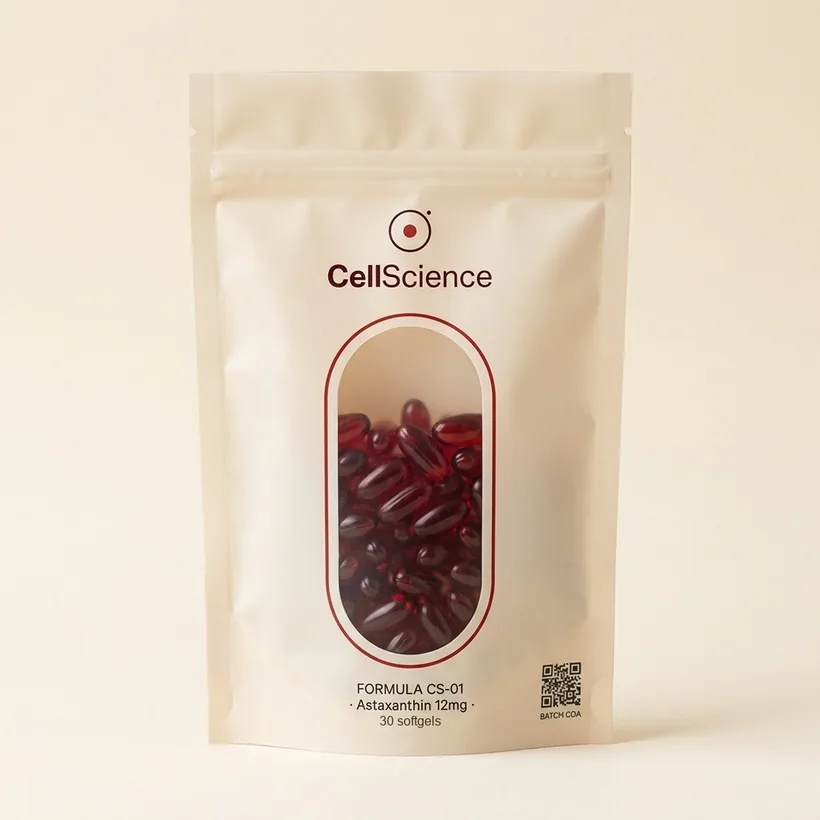
What got me to order was the guarantee. It is a 30-Day Money-Back Guarantee, and you keep the bag. The worst case was thirty days and my money back.
What I felt, week by week, on one softgel a day
I told myself I'd tell this part straight. I had already paid for one bottle that promised “complete.”
You can't feel your kidneys, so I wrote down what I could feel.
Week one: nothing. I took one softgel with breakfast and felt the same. I had expected that, because you don't feel a shield.
What did change was me. For the first time since that Tuesday, I was doing more than waiting.
Week two. Three o'clock came and I wasn't heading for the couch. I got through supper and the dishes without sitting down. My afternoons were the first to change.
Week four. The small print on my pill bottles stopped making my eyes burn. I hadn't even bought the softgel for my eyes.
Week six. My stomach was calmer after dinner, with less bloating. I'd forgotten what a quiet stomach felt like.
“You're not dragging by supper anymore,” my husband said. “What changed?”
One softgel a day had changed. Nothing else.
In week seven the patient portal sent me an appointment reminder. I opened it with both eyes.
By then it was a habit, like winding the kitchen clock. One softgel beside the coffee maker, every morning.
What one astaxanthin softgel a day will not do
The Cell Shield is not a medicine. One softgel a day does not replace your doctor, your tests, or anything you've been prescribed.
And nobody should promise you what a softgel will do to a number on a lab sheet. I won't.
I kept my six-month date. I told my doctor everything I take. If you take blood thinners, or have a diagnosed kidney condition, ask your doctor before you start.
My next kidney test
Six months after that first sheet, I sat in the same chair.
This time I hadn't spent the week dreading the email. I had spent six months doing something.
My doctor read the new sheet line by line, and I watched her face. Then she set the next date, six months out. We are still watching.
I left with a date on a card, the same as the first time. But I had walked in steady, and that was new.
That night I left my laptop shut. I had nothing left to look up at two in the morning.
For months I had been a woman who waits. Tested, watched, told to come back. My mood hung on one number. I have a garden and two grandsons to keep up with. I'd rather be a woman who does something.
My body had not turned on me. It needed help in a place I couldn't reach.
Two ways to spend the six months before your next kidney test
You can do what I did at first. Drink the water. Read the labels. Hold your breath when the email comes.
Or you can watch and protect at the same time. Keep your appointments. And put a guard where the rust starts, inside your kidney cells. That guard has a name, The Cell Shield, and it takes one softgel a day.
How to run your own 30-day test of one softgel a day
Trying it is the easy part, because the 30-Day Money-Back Guarantee covers the test. Don't take an ad's word for it, and don't take mine. Run your own test, in your own kitchen.
Today. Choose how to start. One bag is a one-time order. The free trial turns into a monthly plan after two weeks, and one click cancels it.
Every morning. One softgel, with a meal that has some fat in it. Eggs, yogurt, half an avocado.
The day your bag arrives. Write down how your afternoons feel. Week four. Read it back. If nothing is better, send one email before day thirty and get your money back. If you're on the monthly plan, cancel it that day too. You keep the bag.
Then keep your next test on the calendar, and tell your doctor what you take. I can't promise you a number. I can promise you'll walk in having done something.
You've stayed with me this long, and I think I know why. You're tired of only watching, the way I was. Three short questions come next.
Answer 3 questions and SAVE UP TO $270!
Your result
Your answers match what CellScience Astaxanthin was made for.
Save $270 is the 6-bag price: $14.99 a bag instead of $59.99. Every order has the 30-Day Money-Back Guarantee.
P.S. You may wonder why your doctor never brought this up. I asked mine. A doctor watches and prescribes. A softgel made from microalgae isn't a prescription, so it isn't on her list.
That doesn't make watching wrong. It just leaves you six months with nothing to do. What you do at your own breakfast table was always yours to decide.
One last thing, because I'd want to know. Most people take astaxanthin without any trouble. If you have a diagnosed kidney condition, or you take blood thinners or other medicines, ask your doctor or pharmacist first. The same goes if you are pregnant or nursing.
- Review. The aging kidney and oxidative stress in its blood vessels. Acta Physiologica Hungarica, 2007. PubMed 17444279
- Lab study on kidney cells, not people. Astaxanthin and the cell's own defenses under high sugar. Marine Drugs, 2018. PubMed 29621130